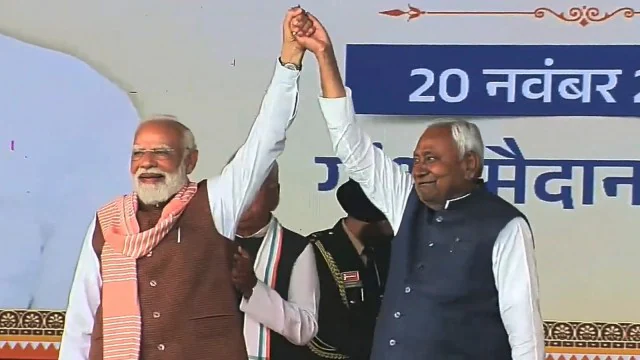
Bhubaneswar: Nitish Kumar has taken oath as the Chief Minister of Bihar once again, marking his record breaking tenth term. The ceremony, though solemn in intent, briefly slipped into the viral space when Prime Minister Narendra Modi was seen wiping his face with a towel — an image that social media amplified instantly. But beyond fleeting moments and political optics lies a far more serious question for Bihar’s citizens: What does this coalition government actually mean for the state’s future?
Bihar today stands at a delicate crossroads. The return of Nitish Kumar, a seasoned administrator but also a leader known for shifting alliances, raises both hope and caution. Coalition governments in Bihar have historically carried the weight of contradictions — alliances bound not by ideology but by political arithmetic. This version is no different.
The fundamental challenge remains: Can Bihar afford yet another cycle of political compromises at the cost of developmental urgency?
Bihar’s chronic issues — unemployment, migration, industrial stagnation, weak law and order, and limited fiscal capacity — require consistent policy, firm leadership, and institutional discipline. However, coalition structures often result in divided authority. With multiple power centers operating under one roof, governance risks drifting into appeasement politics rather than long-term planning.
Nitish Kumar has, undeniably, delivered results in past years: improvements in rural roads, electricity supply, and girl-child education stand to his credit. But these gains require momentum — not merely maintenance. That momentum hinges on one factor alone: political stability.
The new coalition’s stability is already under quiet scrutiny. The alliance appears more like a pragmatic arrangement than a partnership of shared vision. Without cohesion, the government may find itself firefighting internal disagreements rather than addressing Bihar’s deep economic vulnerabilities.
Bihar cannot afford this. Not when millions of its youth still leave the state in search of basic livelihood. Not when industries hesitate to invest due to uncertain political weather. Not when welfare schemes strain a limited revenue base while infrastructure gaps remain vast.
The onus lies squarely on Nitish Kumar. His leadership in the coming months will determine whether he can unify his coalition partners around a development-first agenda. He must ensure that Bihar does not slip back into the political instability that has historically crippled its growth.
This moment is an opportunity. But also a warning. If this coalition reduces governance to a balancing act of interests, Bihar’s development will stagnate. If, however, Nitish Kumar manages to override political compulsions and enforce a clear administrative vision, the state still has a chance to move forward.
Bihar’s people have waited long enough for consistent progress. They deserve a government that delivers — not one that merely survives.
-OdishaAge