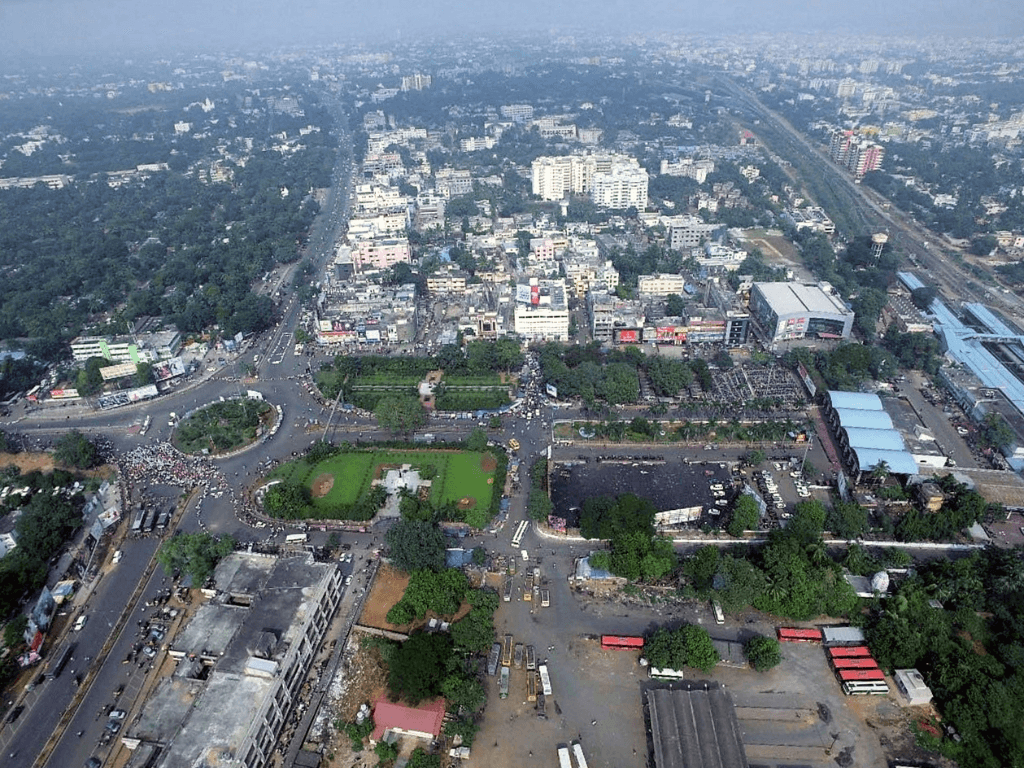
Bhubaneswar: Bhubaneswar is once again at an inflection point. The Housing and Urban Development Minister and BDA Chairman, Dr. Krushna Chandra Mahapatra’s recent inspection of the Town Planning (TP) Schemes in Bijipur, Paikarapur and Sahajpur—and the ambitious New City project—signals the government’s intent to reshape the capital’s future. But behind the confident site visits and glowing presentations lies a larger question: Are we building a city for tomorrow, or repeating the familiar cycle of planning without preparedness?
The TP model, by design, promises structured, predictable urban growth. In theory, it is exactly what Bhubaneswar needs. With the city already under pressure from unregulated expansion, traffic congestion, and inadequate public utilities, the peripheral zones require careful, coordinated development. The government’s renewed push for planned urbanisation, therefore, deserves acknowledgement.
Yet, this moment calls for more than optimism. It calls for oversight, transparency and grounded realism.
For instance, while TP schemes can create modern, well-serviced neighbourhoods, their success depends entirely on accurate land pooling, timely compensation, and tight coordination among multiple agencies—areas in which Odisha has historically struggled. Delays in approvals, disputes over land valuation, and slow infrastructure execution can turn even the most promising projects into sluggish, multi-year ordeals.
Similarly, the much-touted New City project raises both hope and concern. Conceptually, a second urban centre could help decongest Bhubaneswar, distribute economic activity, and create space for large-scale civic infrastructure. But new cities are notoriously complex undertakings. Without clear public disclosures on financing models, environmental impact, transit connectivity and long-term governance, the project risks becoming yet another glossy vision that outpaces ground reality.
Most importantly, urban expansion must be pursued with the people—not merely around them. Peripheral villages that fall within project zones often face the double burden of displacement and delayed benefits. For planned growth to be truly inclusive, local communities must have a voice in shaping these transformations. Transparent grievance redressal mechanisms, fair compensation, and proper rehabilitation are not optional—they are imperative.
The government’s ambition must now be matched by accountability. What Bhubaneswar needs is not just new maps and wider boundaries, but a framework that guarantees that these plans materialise without compromising equity.
If implemented with sincerity and precision, the TP schemes and the New City project could indeed mark the next great chapter of Bhubaneswar’s evolution. But the city has reached a stage where the public can no longer be satisfied by announcements alone. What matters is execution—orderly, timely, and people-centric.
Bhubaneswar deserves a future defined by smart planning, not sprawling promises.
-OdishaAge