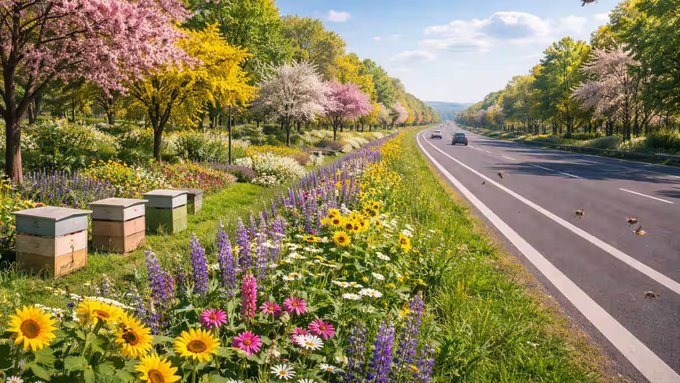
Bhubaneswar: India’s highways have long symbolised speed, connectivity, and economic progress. But they have also represented ecological disruption—fragmented habitats, declining wildlife populations, and vanishing pollinators. Against this backdrop, the National Highways Authority of India’s proposal to create ‘Bee Corridors’ along national highways is a welcome, if overdue, intervention.
Pollinators such as bees are not mere environmental ornaments; they are cornerstones of food systems and biodiversity. Nearly three-quarters of global food crops depend, at least partially, on pollination. Yet urbanisation, intensive agriculture, pesticide overuse, and infrastructure expansion have steadily eroded their habitats. Highways, while critical for economic integration, often cut through forests and farmlands, further accelerating ecological fragmentation.
The Bee Corridor initiative attempts to turn this challenge into an opportunity. By planting native flowering trees such as Neem, Karanj, and Jamun along highway stretches, the government aims to create linear ecological lifelines that offer nectar, pollen, and shelter to pollinators throughout the year. If implemented effectively, these corridors could function as micro-habitats and migratory pathways, reconnecting fragmented ecosystems.
However, the success of this initiative will depend on execution, not announcements. Planting trees is easy; sustaining them is not. Maintenance, pesticide regulation, community participation, and scientific monitoring will determine whether Bee Corridors become thriving ecosystems or merely symbolic green belts. Moreover, the choice of native species, landscape planning, and integration with broader conservation strategies will be crucial.
In an era of climate stress and biodiversity collapse, infrastructure projects can no longer afford to be ecologically blind. The Bee Corridor programme signals a shift in thinking—from infrastructure versus environment to infrastructure with environment. If scaled up and managed rigorously, it could set a global precedent for green highways.
India has built some of the world’s longest road networks. Now, it must ensure those roads do not lead nature to a dead end.
-OdishaAge