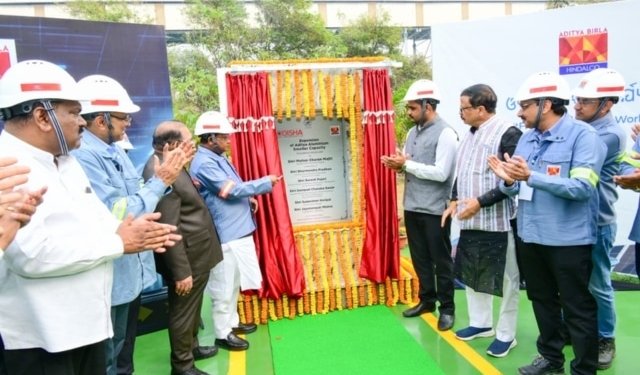
Bhubaneswar: The inauguration of India’s first Flat Rolled Products (FRP) aluminium unit at Hindalco’s Aditya Aluminium plant in Lapanga is strategically significant—not just as an industrial milestone, but as a signal of Odisha’s evolving economic model.
Traditionally viewed as a mineral-rich but value-exporting state, Odisha has long supplied raw materials while downstream value addition occurred elsewhere. The ₹26,996 crore FRP investment directly challenges this pattern by anchoring high-value aluminium processing within the state. Flat rolled products are critical inputs for sectors such as electric vehicles, aerospace, renewable energy, packaging, and advanced construction—placing Odisha higher in the industrial value chain.
Employment impact is another key dimension. While the direct job creation figure of 5,012 may appear modest relative to the investment size, FRP units are capital-intensive by design. Their real employment multiplier lies in downstream manufacturing—fabrication units, MSMEs, logistics, and ancillary industries—particularly across Western Odisha. This aligns with the Chief Minister’s emphasis on employment-led industrialisation rather than extraction-led growth.
From a policy perspective, the project strengthens Odisha’s credibility as an investor-friendly manufacturing destination. The Chief Minister’s reference to nearly ₹20 lakh crore in investment proposals and 15 lakh projected jobs suggests a deliberate attempt to reposition the state in national industrial competition, especially against established manufacturing hubs in western and southern India.
Regionally, locating the project in Sambalpur district is significant. Western Odisha has historically lagged behind the coastal belt in industrial and social indicators. Large anchor investments like this, combined with platforms such as the CII Enterprise Odisha Exhibition 2026 in Rourkela, indicate a conscious effort to decentralise industrial growth and reduce regional disparities.
Finally, the Chief Minister’s framing of development—measured through jobs, security, education, and healthcare—reflects a governance narrative that ties industrial expansion to social outcomes. This is crucial in sustaining political and public legitimacy for large-scale industrialisation in a state where land, environment, and livelihood concerns remain sensitive.
In sum, the FRP unit represents more than a factory opening. It marks Odisha’s transition from a raw-material economy toward a manufacturing-led growth model, with Western Odisha positioned as a new industrial engine rather than a peripheral beneficiary.
-OdishaAge