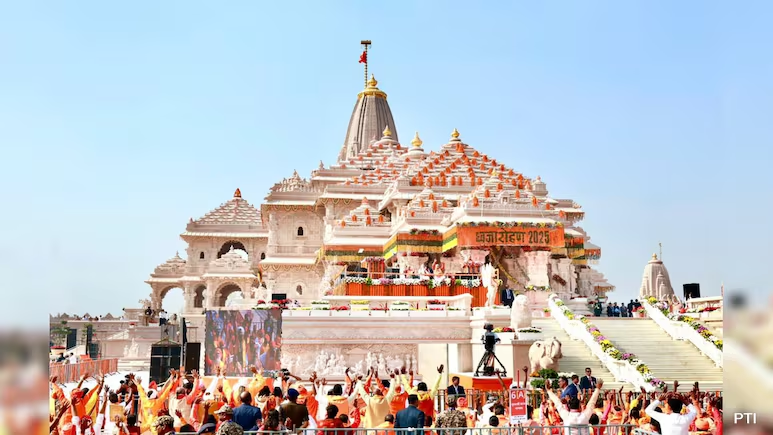
Bhubaneswar: The hoisting of the saffron Dhwaja atop the newly completed Shri Ram Janmabhoomi Temple marks far more than the culmination of a monumental construction project. It is the arrival of a moment that blends religion, culture, politics, and national identity—each layered with its own meaning, each carrying its own weight.
On Tuesday, when Prime Minister Narendra Modi performed the ceremony in the presence of RSS chief Mohan Bhagwat and other dignitaries, the message was unmistakable: this was not just a spiritual event, but a cultural assertion, a political statement, and a civilisational milestone.
The Cultural Dimension: Reclaiming a Civilisational Symbol
The Prime Minister’s words—“Ram is not a person, Ram is a value”—reflect an evolving narrative around the Ayodhya temple. The saffron flag, traditionally a symbol of dignity and spiritual authority, has long been central to the Indian cultural psyche. Its hoisting on the temple Shikhar signals a reclamation of symbols that were, for decades, contested, politicised, and sometimes pushed to the margins of public discourse.
For many, the moment represents the restoration of a cultural equilibrium disrupted by centuries of socio-political upheavals. The Dhwaja becomes, therefore, not merely a temple marker but a civilisational marker—symbolising continuity, identity, and unity.
The Political Lens: Consolidation through Cultural Capital
Yet, any analysis of the ceremony must acknowledge its political dimension. The Ram Temple has shaped the trajectory of Indian politics for over three decades. Its completion—and now the ceremonial crowning with the saffron flag—comes at a time when the ruling party seeks to consolidate cultural nationalism as a core pillar of its political capital.
The presence of the Prime Minister, at the centre of both the ceremony and its symbolism, is not incidental. It underscores the merging of cultural aspiration with political leadership. Critics argue that such moments blur the lines between state and religion; supporters counter that no democratic nation can ignore the sentiments of the majority, especially when such sentiments are rooted in cultural heritage.
This tension—between celebration and critique—is part of the complex political story that Ayodhya continues to write.
The Social Equation: Unity or Assertion?
The saffron Dhwaja is a unifying symbol for millions of devotees across the world. But the true test of its significance lies in how it shapes social narratives going forward.
Will the hoisting of the flag usher in a renewed spirit of cultural confidence and unity?
Or will it deepen the rhetoric of cultural superiority and identity-based political mobilisation?
The answer will determine the social legacy of this moment far more than the ceremony itself.
A Moment of Pride, and a Moment of Responsibility
There is no denying that this is a moment of pride for countless Indians. The Ayodhya Ram Temple—once a distant dream, then a site of conflict, and finally a project of national focus—now stands in its full form, its saffron Dhwaja billowing against the sky.
But as the Prime Minister said, Ram is a value.
Values demand responsibility.
If this moment is to be truly historic—not just emotional—it must inspire:
-
tolerance, not triumphalism;
-
unity, not uniformity;
-
cultural pride, not cultural dominance;
-
dialogue, not division.
The Dhwaja atop the temple is a symbol of civilisational continuity. But its true meaning will be decided by the choices India makes in the days ahead.
Ayodhya has given the country a powerful cultural symbol.
What India does with it will shape the next chapter of its civilisational journey.
-OdishaAge