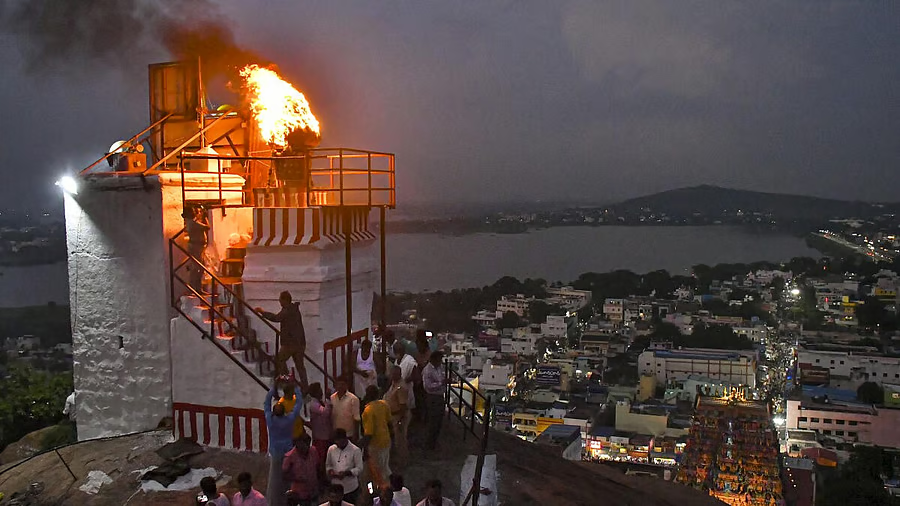
Bhubaneswar: The recent Deepam lighting row in Tamil Nadu has once again brought to the surface a long-simmering debate in Indian public life: where does secular governance end and where does the freedom to practise faith begin? The controversy, triggered by the state government’s decision to prevent Hindu devotees from lighting diyas or lamps in an ancient temple—an age-old ritual—has sparked sharp political reactions and public unease across the state.
For generations, lighting lamps in Hindu temples has symbolised prayer, gratitude and continuity of tradition. It is not a new practice, nor one invented for political mobilisation. That such a ritual is suddenly viewed as a threat to secularism raises troubling questions about selective interpretation of secular principles.
Secularism, as envisioned in the Indian Constitution, does not mean the erasure of religious expression from public life. It means equal respect for all religions and non-interference unless public order, health or morality are genuinely at risk. In this case, the absence of any clear safety or legal justification has allowed the perception to grow that administrative power is being exercised not neutrally, but ideologically.
The political fallout has been swift. Opposition parties have accused the government of appeasement politics and cultural insensitivity, while the ruling dispensation argues it is merely enforcing secular discipline in public institutions. Yet, this defence rings hollow when similar restrictions are not uniformly applied across religious practices. Secularism cannot be enforced by curbing one faith’s visible traditions while accommodating others.
More concerning is the message such actions send to ordinary devotees. When rituals practised peacefully for centuries are abruptly curtailed, it alienates citizens from the very institutions meant to serve them. Faith, after all, is not merely belief—it is lived experience, woven into daily routines, festivals and communal memory.
Tamil Nadu has a proud legacy of social reform and rationalist thought, but it also has a deep and ancient spiritual heritage. The two have historically coexisted, sometimes uneasily, but rarely through outright suppression. Turning temples into battlegrounds for ideological assertion risks deepening divisions rather than fostering harmony.
The Deepam controversy is not just about lamps. It is about trust between the state and its people, about whether secularism is being used as a shield for neutrality or as a sword against tradition. A mature democracy must accommodate faith without fear and govern without bias.
If secularism becomes a pretext to silence cultural expression, it ceases to be inclusive. And when governance appears to police belief rather than protect rights, the flame of democracy itself begins to flicker—no matter how many lamps are left unlit.
-OdishaAge