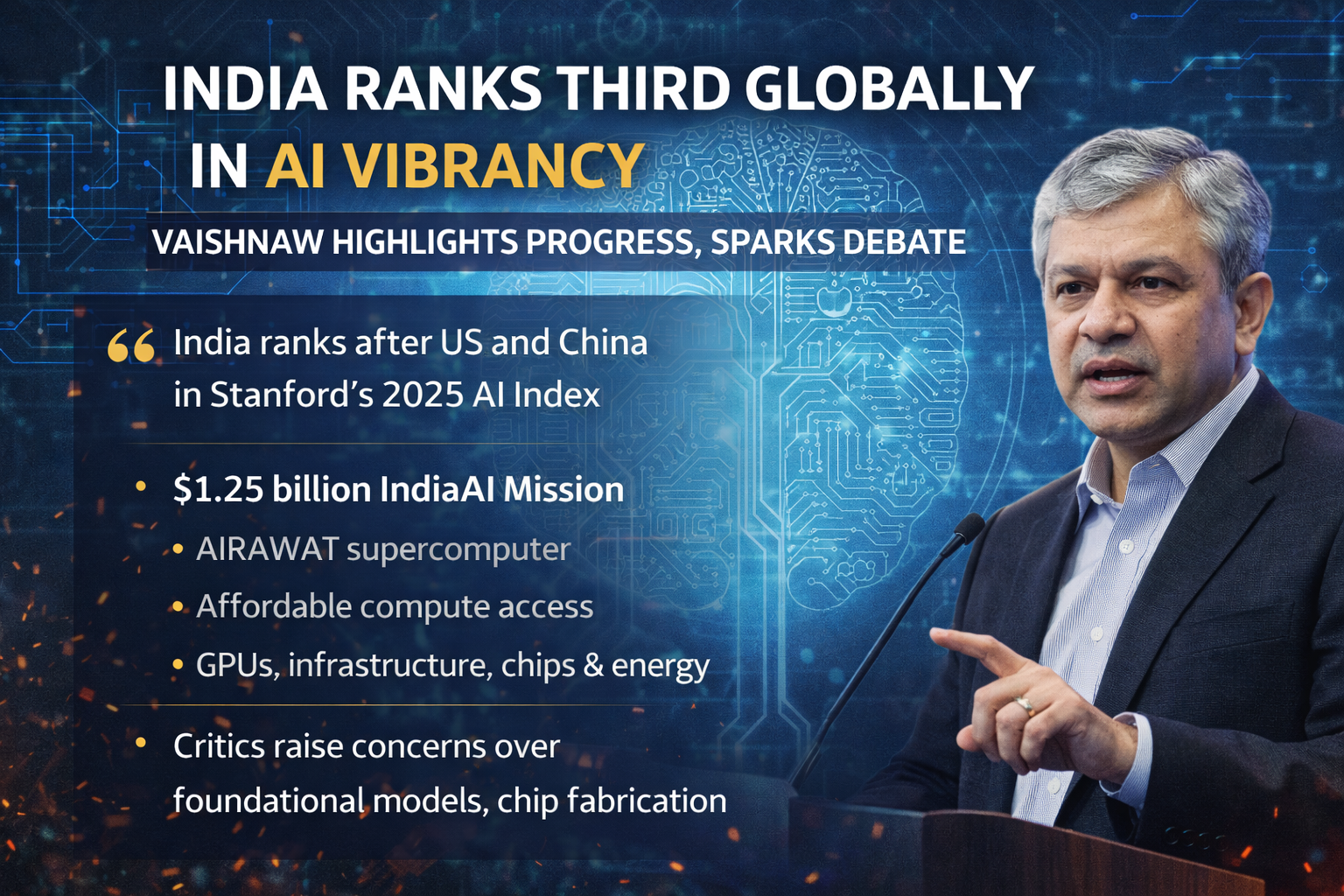
Bhubaneswar: Union Minister Ashwini Vaishnaw has highlighted India’s rise to third place globally in Stanford University’s 2025 AI Index for AI vibrancy, talent, and penetration—behind only the United States and China. The ranking underscores India’s growing footprint in artificial intelligence, driven by a large talent base and rapid adoption across sectors.
Addressing the developments, Vaishnaw outlined progress across AI’s five critical layers—applications, models, chips, infrastructure, and energy—under the government’s $1.25 billion IndiaAI Mission. The initiative focuses on strengthening national AI capabilities through investments in high-performance GPUs, supercomputing infrastructure such as AIRAWAT, and affordable access to compute resources for startups, researchers, and innovators.
Supporters view the achievement as validation of India’s strategy to scale AI adoption across governance, industry, and public services, leveraging a workforce of nearly 1.6 million AI and tech professionals. However, critics argue that gaps remain in foundational model development and domestic chip fabrication, raising questions about whether true AI leadership should be measured by frontier innovation or by large-scale, inclusive deployment.
The discussion has reignited a broader debate on India’s AI trajectory—whether its strength lies in pioneering cutting-edge models or in building a globally significant, scalable AI ecosystem powered by talent, infrastructure, and real-world applications.
-OdishaAge