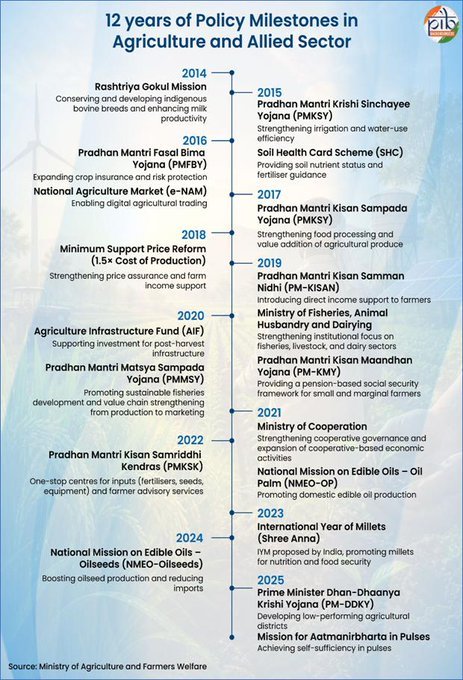
Bhubaneswar: India’s agricultural sector has undergone a significant transformation over the past 12 years, with government policies increasingly focused on empowering farmers through higher productivity, improved income security, stronger market access, and enhanced resilience against climate and economic challenges.
The shift marks a move beyond traditional welfare measures toward a comprehensive approach aimed at building a modern, technology-driven, and farmer-centric agricultural ecosystem. Increased public investment, expanded irrigation networks, easier access to institutional credit, and broader insurance coverage have played a key role in strengthening the rural economy and boosting agricultural output.
Agriculture and allied sectors have witnessed steady growth during this period, supported by targeted interventions designed to improve productivity and sustainability. Enhanced irrigation infrastructure has helped reduce dependence on erratic rainfall, while greater access to credit has enabled farmers to invest in modern equipment, quality inputs, and diversified farming activities.
Income security for farmers has also received a major boost through the expansion of Minimum Support Price (MSP) operations and procurement systems. These measures have provided market assurance for key crops, ensured remunerative prices, and contributed to the country’s food security objectives.
Risk mitigation has emerged as another important pillar of agricultural development. Expanded crop insurance coverage has offered protection against natural disasters, extreme weather events, and crop losses, helping farmers manage uncertainty and maintain financial stability.
Technology is increasingly transforming the agricultural landscape. Digital platforms are providing farmers with access to market information, weather forecasts, advisory services, and online trading opportunities. The growing adoption of digital tools is improving efficiency, transparency, and connectivity across the agricultural value chain.
The government has also promoted the growth of allied sectors such as dairy, fisheries, animal husbandry, and beekeeping, creating additional income opportunities for rural households. Simultaneously, investments in food processing, storage infrastructure, and value addition have helped reduce post-harvest losses and increase farmers’ earnings.
Climate-resilient agriculture has gained prominence as policymakers seek to address the challenges posed by changing weather patterns. Initiatives promoting sustainable farming practices, efficient water management, and resilient crop varieties are helping build long-term agricultural sustainability.
These developments have collectively contributed to a gradual transformation of Indian agriculture into a more diversified, resilient, and innovation-driven sector. As the country continues to strengthen its agricultural foundations, the focus remains on improving farmer incomes, enhancing competitiveness, and ensuring sustainable growth for the millions of annadatas who form the backbone of India’s economy and food security.