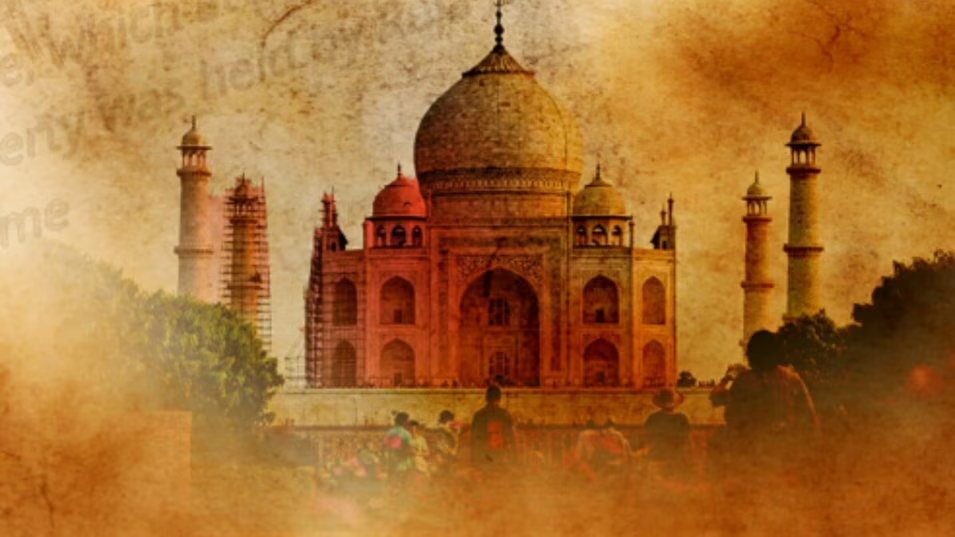
Bhubaneswar: An upcoming Bollywood film, The Taj Story, starring Paresh Rawal, is placing one of India’s most celebrated monuments—the Taj Mahal—back in the spotlight by questioning its origin. The film poses the provocative question: Was the Taj Mahal built by Emperor Shah Jahan as a mausoleum, or does it have earlier roots as a Hindu temple?
The trailer, released on October 16, 2025, presents the monument’s story as a courtroom drama in which Rawal’s character, Vishnu Das, demands a DNA test of the Taj to decide whether it is a tomb or a temple.
The film is directed and written by Tushar Amrish Goel and is scheduled for release on October 31, 2025.
The motion-poster of the film sparked strong reactions when it depicted a Shiva idol emerging from within the dome of the Taj Mahal—a visual which led many to accuse the film of reviving the so-called “Tejo Mahalaya” theory. This theory claims the Taj was originally a Hindu temple before the Mughal era.
Following the backlash, the makers released a statement on September 30 clarifying: “The makers of the film The Taj Story clarify that the movie does not deal with any religious matters, nor does it claim that a Shiv temple resides within the Taj Mahal. It focuses solely on historical facts.”
According to the Archaeological Survey of India (ASI) and most historians, the Taj Mahal was built by Shah Jahan in the 17th century for his wife Mumtaz Mahal. An ASI affidavit in 2018 reaffirmed the monument’s status as a mausoleum and rejected the temple-origin claim. Famous historian William Dalrymple has dismissed the temple-theory as “malicious nonsense” with no factual backing.
While the film is being positioned as a historical investigation, critics argue it may be tapping into contemporary ideological debates around heritage and identity. Some feel the narrative could stir communal or political sentiments by challenging an established monument’s history. The makers, however, maintain that The Taj Story aims to spark discussion rather than deliver definitive judgments on history.
-OdishaAge