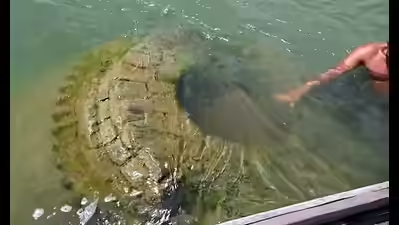
Bhubaneswar: Spectacular underwater visuals captured by divers beneath the Mahanadi River near Nandikeswari Path on the Cuttack–Choudwar stretch have revealed massive rocky formations resting quietly on the riverbed. Resembling submerged hills or cliffs, the formations have sparked curiosity about the geological history hidden beneath one of Odisha’s most important rivers.
At first glance, the enormous rock structures appear almost otherworldly, prompting questions about whether they are simply natural formations or remnants of an ancient landscape preserved beneath the flowing waters.
According to geologists, the Mahanadi is a dynamic river that has changed its course multiple times over thousands of years. Scientific studies have identified evidence of ancient river channels, sandstone formations, and long-term geological processes across the region, suggesting that the river has evolved continuously over millions of years. These submerged rock formations are therefore likely to be part of the river’s natural geological history rather than recent features.
At present, there is no archaeological evidence to suggest that the formations are linked to an ancient civilisation or submerged settlement. However, experts believe that detailed geological mapping, underwater exploration, and archaeological investigations could provide valuable insights into the evolution of the Mahanadi basin and the historical landscape of the Cuttack region.
Whether they are sculpted solely by nature over millions of years or hold clues to Odisha’s distant past, these remarkable underwater formations highlight the hidden geological heritage of the Mahanadi and the importance of continued scientific exploration.
-OdishaAge