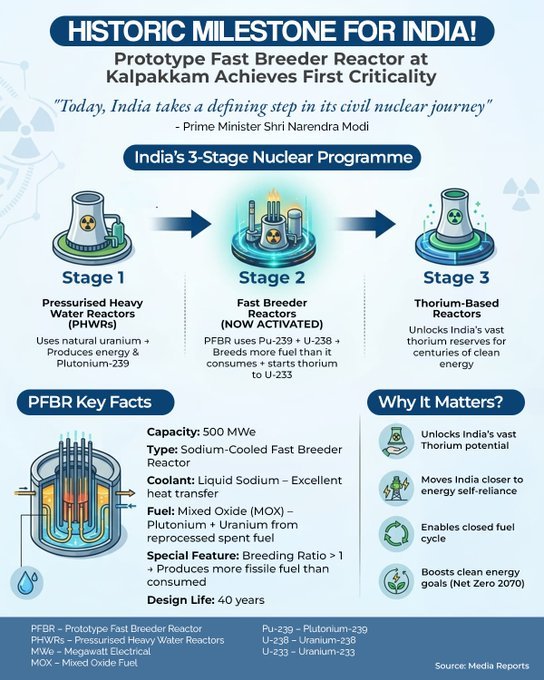
Bhubaneswar: In a major advancement for India’s nuclear energy programme, the indigenously developed Prototype Fast Breeder Reactor (PFBR) at Kalpakkam has successfully achieved criticality, marking a significant breakthrough in Stage-2 of India’s three-stage nuclear power strategy.
The 500 MWe sodium-cooled fast reactor represents a crucial technological leap. It operates using mixed oxide (MOX) fuel—a combination of plutonium and uranium derived from reprocessed spent fuel—enabling a closed fuel cycle. This approach not only enhances fuel efficiency but also allows the reactor to generate more fissile material than it consumes.
A Key Step in India’s Three-Stage Nuclear Programme
India’s long-term nuclear roadmap is structured around a three-stage approach:
-
Stage-1: Pressurised Heavy Water Reactor using natural uranium
-
Stage-2: Fast Breeder Reactors like the PFBR, which utilize plutonium-based fuel
-
Stage-3: Future thorium-based reactors aimed at tapping India’s vast thorium reserves
The successful operation of the PFBR is critical for transitioning from uranium-based energy production to a sustainable thorium-driven cycle.
Strategic and Energy Implications
With a breeding ratio greater than 1, the PFBR can produce more fissile material than it consumes—an essential feature for long-term nuclear sustainability. The reactor has a projected operational life of around 40 years.
This milestone strengthens:
-
Energy security by reducing reliance on imported fuel
-
Sustainability through efficient fuel utilization and reduced nuclear waste
-
Clean energy goals by expanding low-carbon power generation
The achievement places India among a select group of nations with advanced fast breeder reactor technology, reinforcing its position in the global nuclear energy landscape.
-OdishaAge