Bhubaneswar: The killing of Mani Chakraborty, a Hindu grocery trader in Narsingdi, is not merely another entry in Bangladesh’s crime statistics. It is the sixth fatal attack on Hindu men in less than three weeks, and together these killings form a troubling pattern that speaks less about individual acts of violence and more about a state struggling to enforce authority during political transition.
Hindu minorities in Bangladesh have long occupied a precarious position—economically significant yet politically marginal. Small traders, shop owners and landholders are often visible in local economies, but lack the political patronage networks that offer protection during periods of unrest. History shows that whenever Bangladesh’s state apparatus weakens, minorities absorb a disproportionate share of the resulting disorder.
What distinguishes the current moment is not simply the violence, but the context in which it is occurring. The departure of Sheikh Hasina marked the end of a deeply centralised governance model. Her administration was criticised for authoritarian excesses, but it maintained a disciplined and responsive security structure that moved swiftly to contain communal flare-ups. That structure, however, was heavily dependent on top-down political command.
The interim government led by Muhammad Yunus has inherited institutions designed to operate under a single political centre. Once that centre vanished, the system did not decentralise—it stalled. Police forces across districts are reportedly operating with hesitation, uncertain about political authority, legal backing and institutional support. In such environments, law enforcement prioritises risk avoidance over proactive intervention, creating precisely the conditions in which targeted violence thrives.
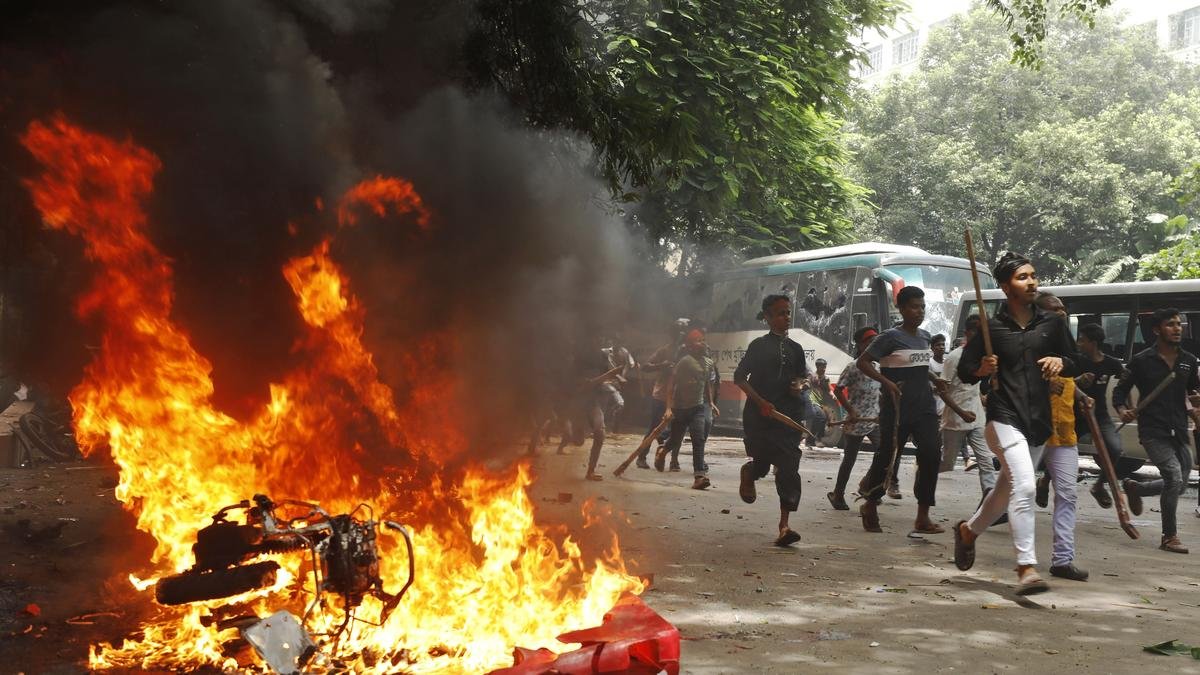
The killings of Hindu traders reflect this enforcement vacuum. When attacks occur in crowded public spaces and perpetrators escape without identification, it suggests more than criminal audacity—it signals a calculation that consequences are unlikely. The message to vulnerable communities is clear: the state’s attention is elsewhere.
Bangladesh has faced political upheaval before, but the present phase is marked by a dangerous convergence of institutional fragility and communal anxiety. Minority violence is rarely spontaneous. It flourishes when administrative paralysis intersects with social prejudice, and when perpetrators sense that accountability mechanisms are weakened or distracted.
If left unaddressed, this trend risks eroding not only minority confidence but also Bangladesh’s broader claim to social stability. Communal violence has a corrosive effect on governance, investor confidence and international credibility—costs that extend far beyond the immediate human tragedy.
Restoring order will require more than rhetorical reassurances. The interim administration must urgently establish clear command structures for policing, demonstrate visible accountability for communal crimes, and communicate unequivocally that political transition does not mean institutional abdication. Without this, the killings will continue to be read—not as isolated crimes—but as symptoms of a state losing its grip on those it is meant to protect.
The death of Mani Chakraborty is therefore not just a tragedy for one family or community. It is a stress test for Bangladesh’s institutions, and so far, the results are deeply unsettling.
-OdishaAge